The FAA Modernization of Special Airworthiness Certification (MOSAIC) rule is one of the most significant changes to general aviation regulations in nearly two decades. With expanded aircraft eligibility, driver’s license medical privileges and new operational authority, MOSAIC reshapes both general aviation and aviation insurance underwriting. For those who have been following the development of this effort, the wait is over. This article from Global Aerospace details what has been modified and what the sport pilot rule changes in 2026 mean for pilots, brokers and insureds.

Understanding MOSAIC
What is MOSAIC?
MOSAIC (Modernization of Special Airworthiness Certification) is a major update the FAA created to update light‑aviation rules. It was finalized in July 2025 to better reflect modern aircraft technology and pilot needs in the aviation community. The rule is being implemented in two phases: Phase 1 focuses on pilot privileges, training, maintenance and operations and took effect on October 22, 2025; Phase 2 further modernizes aircraft certification standards and enables advanced technology, automation and new aircraft designs and will take effect on July 24, 2026.
Phase 1 (Effective October 22, 2025)
The early phase in MOSAIC primarily affects 14 CFR Parts 61, 91, 43, and 65, which address pilot certification, operating rules and maintenance privileges. With these changes, sport pilots can fly a wider range of aircraft than in the past, including aircraft with a 4-seat configuration, although the regulations still limit flights to only one passenger and one pilot. Weight limits have also been removed; instead, a 59‑knot stall speed limit will be used. Sport pilots, and higher‑rated pilots operating under sport pilot rules, may now use a U.S. driver’s license for daytime flying, while night operations require an FAA medical certificate or meeting the BasicMed requirements.
Phase 2 (Effective July 24, 2026)
Focuses on manufacturers and updates 14 CFR Parts 1, 21, and 22, replacing the legacy weight‑based Light‑Sport Aircraft framework with performance‑based certification standards. These changes support aircraft with advanced avionics, higher levels of automation and non‑traditional powerplants such as electric and hybrid systems, allowing safer and more capable aircraft to be designed and certified.
Transitioning From Weight Limits to Performance
At the heart of MOSAIC is the removal of the traditional weight limitations that previously defined light sport aircraft. For years, the category was capped at a maximum takeoff weight of 1,320 to 1,430 pounds. Under the new rule, the FAA is replacing this cap with a clean stall speed threshold.
Specifically, aircraft must have a maximum clean stall speed (VS1) of 59 knots or less. This single regulatory shift creates a larger selection of various legacy aircraft to be available to sport pilots. This includes models such as the Cessna 150, Cessna 152, Cessna 172 and certain Piper PA-28 models.
Modernizing Medical Qualification Pathways
One of the most discussed aspects of MOSAIC is the expansion of medical qualification pathways. Private, Commercial and Airline Transport Pilot (ATP) certificate holders can now choose to operate under sport pilot privileges using only a valid driver’s license as their medical qualification for FAA purposes.
This path provides significant flexibility for seasoned pilots who may no longer wish to maintain a formal FAA medical certificate but still want to enjoy recreational flying. While this is a welcome change for many, it is vital to remember that pilots must still comply with all FAA standards and limitations when operating under these privileges.
For example, night flying requires an FAA medical or BasicMed and would not be permitted using a driver’s license. Additionally, a driver’s license cannot be used if the pilot has ever had an FAA medical certificate denied, suspended or revoked.
How MOSAIC Affects Aviation Insurance Underwriting
Global Aerospace has updated internal systems to align with the new FAA guidelines, ensuring a seamless transition for sport pilots and Sport Pilot Certified Flight Instructors (CFIs). Our underwriters will assess the risk, remaining focused on pilot competency, proficiency and training.
1. Aircraft Eligibility ≠ Risk Reduction
When considering MOSAIC and the insurance impact, it is important to recognize that the new regulations do not inherently change the physical nature of the aircraft. A particular aircraft carries the same operational risks today as it did before it became sport-eligible, and the risk profile of the airframe remains constant regardless of the pilot’s certificate level. Consequently, underwriting decisions continue to be driven by pilot experience—including flight time, training, type of missions and recent flight frequency—rather than the specific regulatory bucket the aircraft now falls into.
2. Driver’s License Medical—What Insurers Care About
The expansion of the driver’s license medical pathway offers significant flexibility, but it does not change how your policy is structured. Global Aerospace does not require that a switch to a driver’s license medical be reported, provided you remain in full compliance with all FAA regulations and limitations. Because safety standards are maintained through these FAA requirements, moving to this medical pathway does not typically result in a change to your premium or coverage terms.
3. Pilot Application Clarification
When completing insurance applications, accuracy regarding your credentials is essential for proper underwriting. You must always list the highest pilot certificate you have earned, such as Airline Transport Pilot (ATP), Commercial or Private. Even if you are choosing to operate under sport privileges using a driver’s license medical, you still possess your higher-level certificate. Operating under sport privileges does not reduce your certificate level or reclassify you as a sport-only pilot in the eyes of an underwriter.
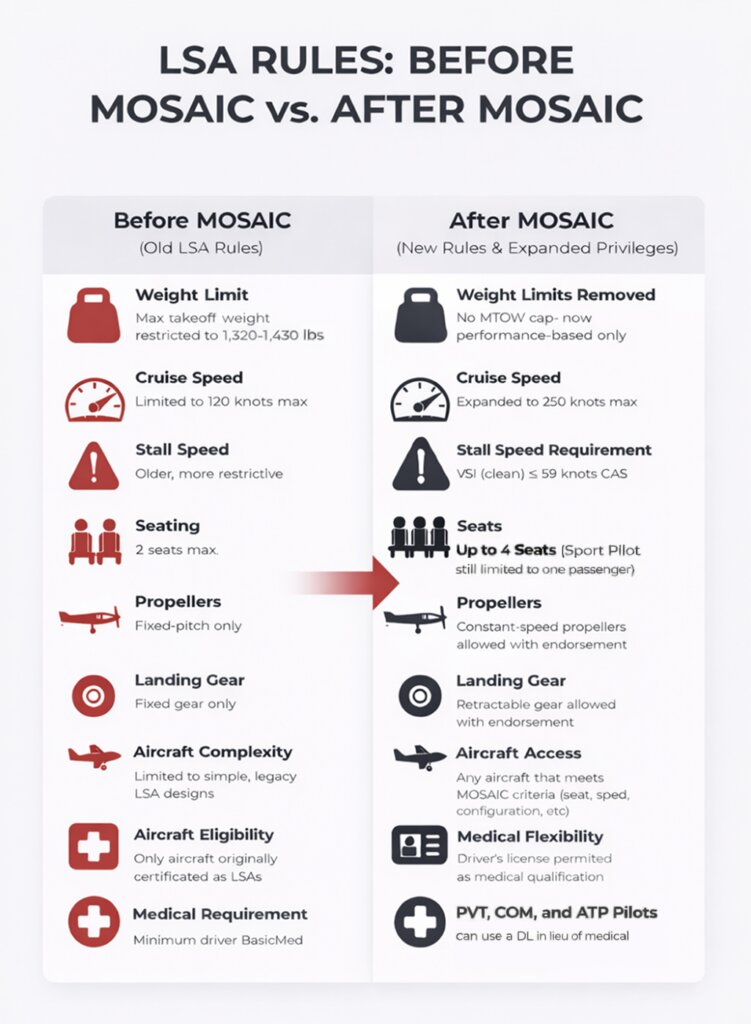
Summary of Key Changes From Pre-MOSAIC to Post-MOSAIC Standards
- Weight thresholds. Aircraft were formerly limited to a maximum takeoff weight of 1,320 pounds for land aircraft and 1,430 pounds for seaplanes. The new standard focuses on a maximum clean stall speed of 59 knots rather than a specific weight limit.
- Medical requirements. Pilots were often required to hold at least a third-class medical or BasicMed to operate larger aircraft. Pilots with higher certificates can now operate eligible aircraft using a driver’s license under sport pilot privileges.
- Aircraft seating. The previous definition of light sport aircraft was strictly limited to two seats. Pilots can now operate aircraft with up to four seats though they are still limited to one passenger.
MOSAIC and Insurance: Frequently Asked Questions
Does MOSAIC lower my premium?
No. Premiums are based on pilot experience and aircraft characteristics—not categorization.
Do I need to notify my insurer if I switch to a driver’s license medical?
No. But you must comply with FAA regulations.
Does becoming sport-eligible make an aircraft “lower risk”?
Not automatically.
Are insurers ready for MOSAIC?
Yes. Global Aerospace systems have been updated to reflect FAA changes.
Preparing for the Phase-In Period
As we move forward under the new regulations, it is important to know that our underwriters are still looking at overall qualities of the pilot—largely focusing on total time, make and model time and that they are properly endorsed to fly under MOSAIC.
We encourage our brokers and clients to contact us with any questions they may have. The aviation industry is built on a culture of safety and effective collaboration, and MOSAIC is no exception. By working together to understand these regulatory shifts, we can ensure that the expansion of flight opportunities is matched by a continued commitment to safety and risk management.
Whether you are a flight school owner or an owner-pilot, Global Aerospace is here to support you while you navigate the future of light aircraft operations. Contact us today for more information or to get an aviation insurance quote.
About Global Aerospace
Global Aerospace has a century of experience and powerful passion for providing aviation insurance solutions that protect industry stakeholders and empower the industry to thrive. With financial stability from a pool of the world’s foremost capital, we leverage innovative ideas, advanced technology and a powerful synergy among diverse team members to underwrite and process claims for the many risks our clients face. Headquartered in the UK, we have offices in Canada, France, Germany and throughout the United States. Learn more at https://www.global-aero.com/
Global Aerospace Media Contact
Suzanne Keneally
Vice President, Group Head of Communications
+1 973-490-8588
Source: SubmitMyPR
Release ID: 2335311
