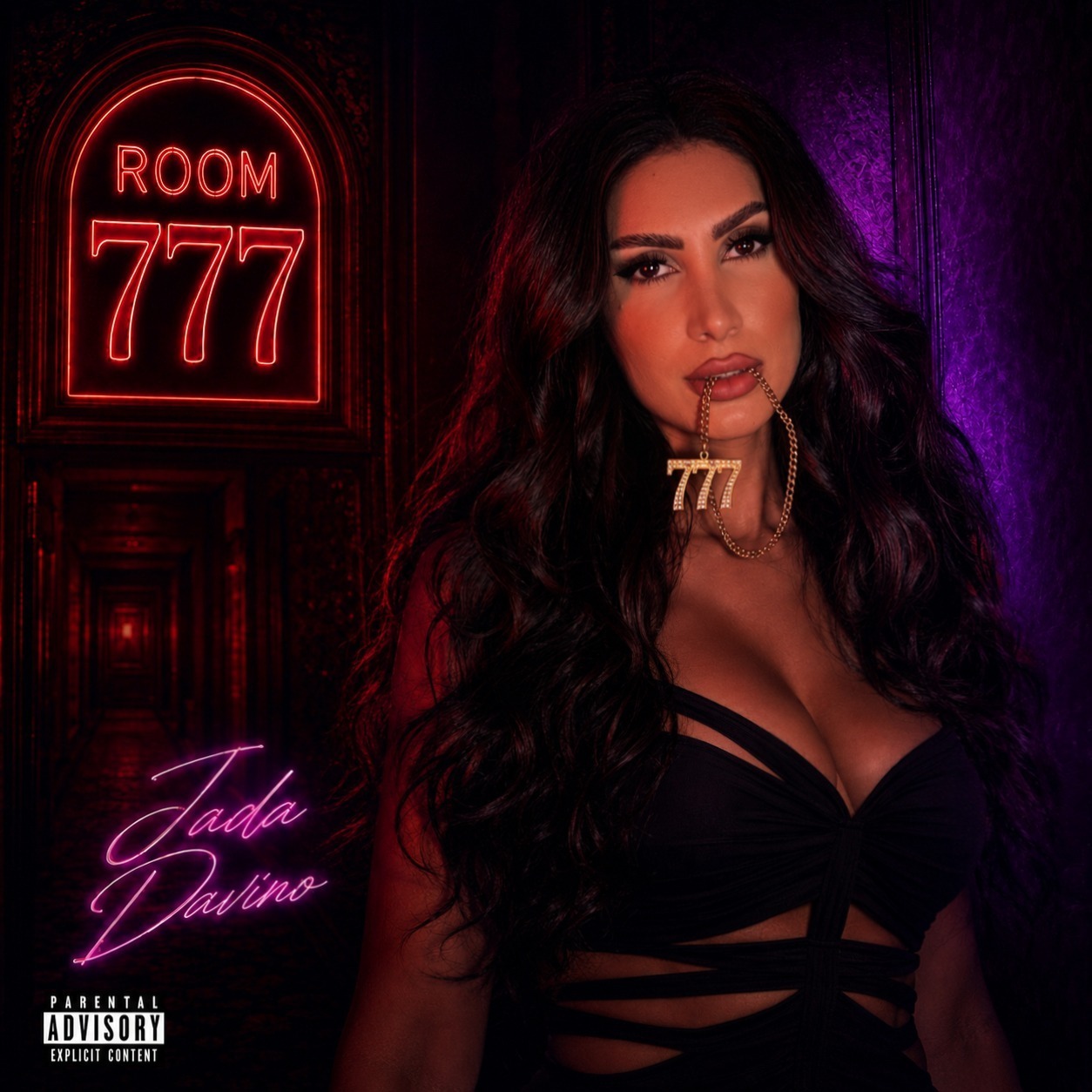
The article and accompanying lyrics profile Jada Davino’s 2026 single, "Room 777," a track she independently wrote, produced, and mastered. The song serves as a declaration of feminine autonomy, focusing on a narrator who dictates the terms of a fleeting encounter without seeking long-term connection. By utilizing the symbolism of the number seven, Davino explores themes of completion and self-possession within a controlled environment. The musical production is described as deliberate and steady, mirroring the protagonist’s refusal to surrender her power to a partner. Ultimately, the source portrays the work as a rejection of traditional romantic expectations in favor of intentional, unapologetic choice. Through this creative project, Davino highlights a narrative of absolute control where the artist and her character remain entirely self-reliant.
Jada Davino New Music Drop Room 777: An Anthem of Absolute Autonomy
Podcast by Billionaire Mind on Coffee With Q
Episode: Jada Davino Built Room 777
Format: Deep Dive · 34:45 Date: June 28, 2026
Sources: Coffee With Q breakdown of "Room 777" + full lyrics
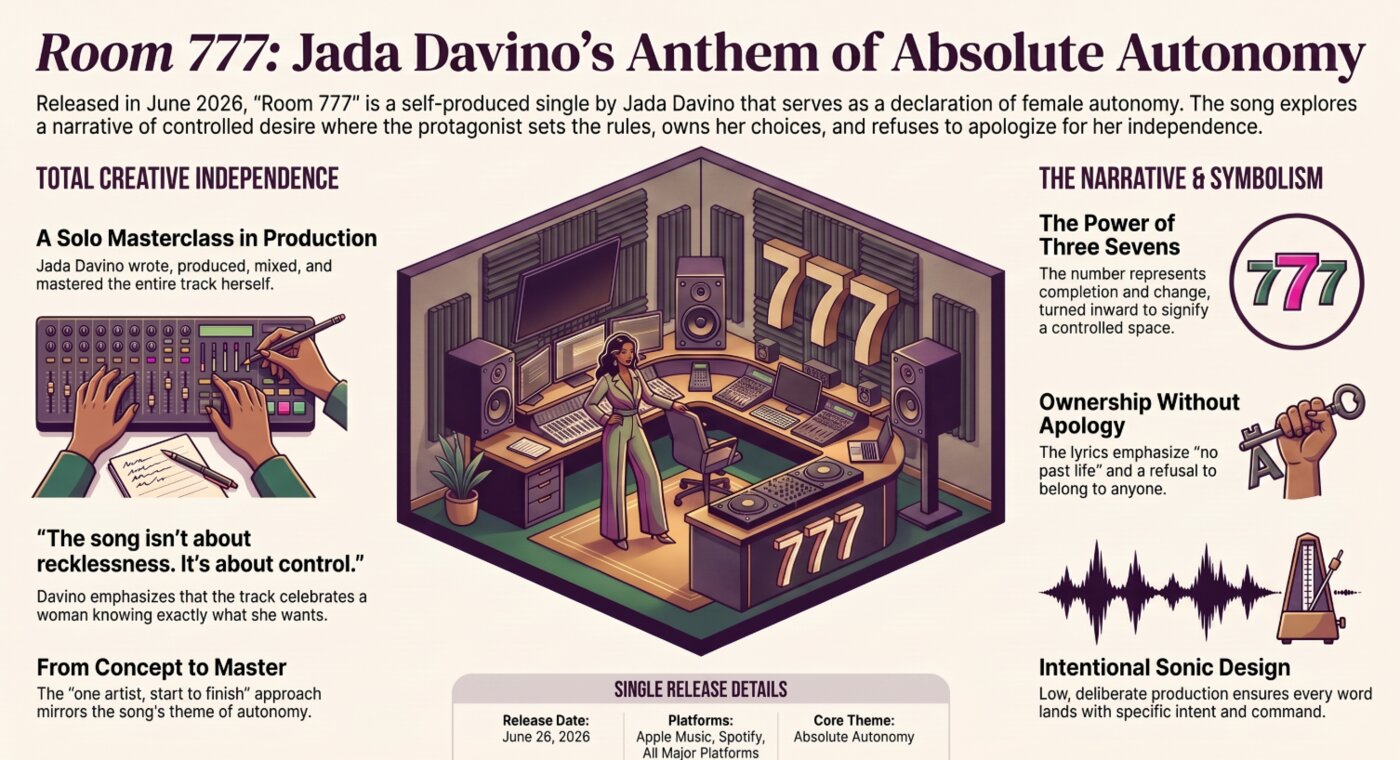
Coffee With Q Editor Explains - An Anthem of Absolute Autonomy - Room 777

“Jada Davino is a bilingual singer-songwriter carving her own lane with a bold fusion of Egyptian heritage and American grit. Her sound blends Mediterranean warmth, sharp lyrical confidence.” Sound Cloud
Episode Summary
The article and accompanying lyrics profile Jada Davino's 2026 single "Room 777," a track she independently wrote, produced, and mastered. The song works as a declaration of feminine autonomy, focused on a narrator who dictates the terms of a fleeting encounter without seeking long-term connection. Using the symbolism of the number seven, Davino explores completion and self-possession inside a controlled environment. The production is deliberate and steady, mirroring the protagonist's refusal to surrender her power to a partner. The work reads as a rejection of traditional romantic expectations in favor of intentional, unapologetic choice. Through the project, Davino builds a narrative of absolute control where the artist and her character stay entirely self-reliant.
The Solo Architect
Host: Imagine deciding to build a mansion, but you totally refuse to hire a crew. No help at all.
Co-host: None.
Host: You are out there pouring the concrete foundation yourself. You frame the walls, you run the electrical wiring, you put on the roof. Which is already exhausting to even think about.
Co-host: Seriously.
Host: And when the structure is finally sound, you don't even stop there. You walk inside, you weave the curtains by hand, you paint the trim, and you sit down to meticulously tune the grand piano in the living room, all by yourself.
Co-host: Exactly. Now imagine doing that, but not for a house. Imagine doing it for a massive chart-topping pop hit.
Host: Oh wow. Yeah. No co-writers to bounce ideas off of. No mix engineers to fix your mistakes. No safety net whatsoever.
Co-host: It's kind of terrifying, honestly.
Host: It really is. But today on the Deep Dive we are tearing down the studs of Jada Davino's new single "Room 777" to show you exactly how a solitary architect built a masterpiece of absolute control.
Co-host: It completely upends the entire modern music industry playbook.
Upending the Industry Playbook
Host: It really does, because if you pull up the credits on almost any massive pop release from the last decade or so, you're basically looking at the closing crawl of a summer blockbuster.
Co-host: It takes a village.
Host: Exactly. The village approach is the standard. You have your topline melody writers, dedicated lyricists, beat makers, vocal producers.
Co-host: And that's just the recording phase.
Host: Right. Then you get a mix engineer who specializes fully in low-end drum frequencies, and another mix engineer who handles the vocal chain, and a mastering guru who adds the final polish.
Co-host: It's literally an assembly line.
Host: It is, and it's an incredibly efficient, highly segmented operation. The industry relies on it because it acts as a system of checks and balances.
Co-host: Kind of like a safety net for creativity.
Host: Yeah. We find a lot of comfort in the idea of specialists. If you are the topline writer, you don't have to worry about whether the kick drum is masking the bass line in the 60 Hz range, because that's not your job.
Co-host: Right. You hand a baton to the next specialist, trusting that every single frequency will be polished to perfection before it hits the radio.
Host: But then you step into the world of absolute, uncompromising creative autonomy, and that entire assembly line grinds to a halt.
Co-host: Totally. The factory is completely empty except for one person sitting in the center of the room, bathed in the glow of a computer monitor.
Host: Which is such a solitary image. We're looking at a creative landscape that is intensely solitary. So welcome to the Deep Dive. Whether you are an aspiring songwriter staring at a blank notebook, a bedroom producer wrestling with your DAW, or an artist trying to figure out how to translate what's in your head into the speakers, we are dissecting a master class in creative autonomy today.
Co-host: We really are. Jada Davino's "Room 777," which dropped on June 26, 2026.
Host: And we were working primarily today from a really brilliant breakdown published by Coffee With Q Media.
Co-host: Highly recommend checking that out, by the way.
Host: Absolutely. We are doing a standard track review today. We are looking at the underlying thesis of what Davino has actually accomplished by acting as the sole architect, because she wrote, produced, mixed, and mastered this track entirely alone. And when you look closely, this beautiful, undeniable symmetry emerges.
The Narrative Mirror
Co-host: The narrative mirror. Yes. You have a lyrical narrative about a woman asserting absolute, unyielding control over her night, her physical environment, and her choices. And that fiction is mirrored flawlessly by the reality of the artist having absolute start-to-finish control over the sonic execution.
Host: It's perfectly aligned. The creator and the character are operating under the exact same parameters.
Co-host: Exactly. One woman, full control.
Host: So if she is the one making every single call to protect that vision, how does that actually manifest when you open up the project file?
Unfiltered Translation
Co-host: That's the big question. When we talk about writing, producing, mixing, and mastering in total isolation, what does that practically mean for the frequencies hitting our eardrums?
Host: It means that every single auditory element is a completely unfiltered translation of the original emotional intent.
Co-host: Unfiltered being the key word there.
Host: Completely. Let's break down the mechanics of typical production for a second. Say a songwriter sits at a piano and writes a very intimate, melancholic chord progression. They feel a specific sorrow in that exact moment. But then the track goes to a producer who is tasked with making it a radio hit.
Co-host: The dreaded radio edit.
Host: Right. So the producer strips out the piano and drops a pulsating four-on-the-floor dance beat underneath it.
Co-host: Meaning a kick drum hitting on every single quarter note to drive the momentum.
Host: Exactly. And suddenly that initial intimacy is compromised. It's gone. Then it goes to a mix engineer, whose job is often to make the track sound competitive on streaming platforms.
Co-host: Make it loud.
Host: Make it loud, make it bright. So they might use an equalizer, or EQ, to drastically boost the high-end frequencies. They make the vocals sparkling and aggressive so they cut through like a cheap car speaker.
Co-host: Right.
Host: And by the end of that assembly line, the original melancholic, intimate intent of the songwriter is heavily diluted.
Co-host: The vision gets blurred by a dozen different fingerprints.
Host: But when Jada Davino sits at the mixing console for "Room 777," she remembers exactly the physical sensation she felt when she penned the first lyric.
Co-host: She doesn't have to explain it to anybody.
Host: Right. She knows exactly how the kick drum needs to behave because she programmed it to match her own heartbeat in that specific moment. The Coffee With Q article explicitly states that the story inside the song follows the same rule as the production. One woman, full control.
Co-host: She picks the room. She sets the rules.
Host: Yes. The production choices are literally the physical rules of the room she has built.
The Terror of Isolation: Demoitis
Co-host: Wait, let me push back on this for a second.
Host: Go for it.
Co-host: If you're an aspiring songwriter or producer and you're writing, producing, and mixing entirely alone in a room for months, don't you completely lose your mind?
Host: Oh, easily. Yes.
Co-host: How do you even know if the snare drum sounds good anymore? If your second verse drags? If you're just experiencing massive ear fatigue? You don't have a sounding board.
Host: You are hitting on the central terror of the solo creator. The industry term for it is demoitis.
Co-host: When you listen to the same snare drum sample or the same vocal take a thousand times in a row, your brain literally stops processing it objectively.
Host: Just tunes it out. Exactly. You lose all perspective on the frequency balance. A mix might be painfully harsh in the high mid-range, around 3 to 4 kHz.
Co-host: That really piercing frequency.
Host: Super piercing. But because you've been listening to it for 10 hours straight, your ears have naturally attenuated to protect themselves.
Co-host: So your body is lying to you.
Host: Basically. You think it sounds warm and balanced when it's actually completely harsh. So it is a massive risk to work without a co-producer or a mixing engineer to provide a reality check.
Co-host: So how does she survive that isolation without the track turning into an unlistenable mess?
Vision as the Antidote
Host: Through a crystal-clear, uncompromising vision that she absolutely refuses to negotiate. The lack of outside input is the defining feature of the track's success. It prevents the song from being watered down by a committee trying to optimize it for a Spotify algorithm.
Co-host: Right, because they'd smooth out all the interesting edges.
Host: Exactly. The article notes that the track reads less like a confession and more like a declaration.
Co-host: I love that phrasing. A declaration.
Host: Think about what happens in a typical co-writing session. If an artist brings in a lyric about a cold, calculated one-night stand, a record executive or a co-writer will inevitably chime in and say, "Can we make her a little more relatable?"
Co-host: Oh my gosh, yes. Maybe she feels a tinge of guilt in the bridge. Maybe she wishes he would stay.
Host: The dreaded "let's make the protagonist sympathetic" studio note. It ruins so many good dark concepts, because they want to soften the edges to make the character universally likable. But because Davino is operating completely autonomously, she can simply reject that instinct.
Co-host: She doesn't even have to hear it.
Host: Right. She owns the choice, and the morning after, just as she literally owns the master recording and the final mix file.
Co-host: That is so cool.
Host: She isn't in a vocal booth confessing her sins to a producer who is judging her through the studio glass.
Co-host: Yeah, that dynamic is completely removed.
Host: She is declaring her reality into a microphone she set up herself in an empty room.
Co-host: The absolute autonomy in the studio allows for the absolute autonomy of the character in the narrative.
Production Choice 1: Low and Deliberate
Host: Okay, let's look at the specific production choices she made to serve these lyrics, because the sonic bed of this track is incredibly specific. The Coffee With Q breakdown describes the production as staying low and deliberate, with no rush in the beat. Let's translate that for the bedroom producers listening right now. What does "low and deliberate" actually look like in the DAW?
Co-host: Well, it starts with an understanding of how pacing and frequency dictate human psychology.
Host: Okay, break that down.
Co-host: Tempo is not just a mathematical grid on your screen. It is a psychological environment. When a track is fast, say 120 beats per minute or higher, and relies on heavy syncopated 16th notes on a hi-hat, it forces a sense of urgency.
Host: It makes your heart race.
Co-host: Literally. It triggers a mild fight-or-flight response in the listener. It can feel like anxiety, desperation, or uncontrollable adrenaline.
Host: Which is great for a club track, but not for this.
Co-host: Exactly. By choosing a slower tempo, by making the beat deliberate, Davino is sonically constructing an environment of total confidence, because she isn't in a hurry. And then think about the physics of low frequencies. A sub-bass wave, say a note hitting around 40 Hz, literally takes more time to complete a single cycle than a high cymbal sound.
Host: Oh, so the sound wave itself is just longer.
Co-host: Much longer. It physically moves massive amounts of air in a room. If you program a super-fast beat, you have to cut the decay tails off your bass notes, otherwise they bleed into each other.
Host: And create a muddy, unintelligible mess.
Co-host: Exactly. By keeping the tempo slow, Davino allows those massive sub-bass frequencies to ring out and decay naturally. The low end breathes.
Host: It takes up physical space.
Co-host: Yes. It makes the track feel incredibly heavy, anchored, and entirely unbothered.
Production Choice 2: The Unstrained Vocal
Host: And that heavy, anchored environment dictates the vocal delivery too, because the article highlights that there is no strain in the vocal and that every word lands with intent.
Co-host: Which is an incredibly disciplined choice for a vocalist to make today, because the pervasive instinct in modern pop music is to push the vocal cords to their absolute limit.
Host: Oh yeah. Singers belt. They rely on all these vocal acrobatics. They push into the upper extremes of their chest register to communicate passion and ensure the listener is paying attention.
Co-host: It reminds me of watching a truly captivating actor on screen. Think of the legendary performances of a mob boss or brilliant manipulator. When they have the most important line of dialogue in the film, they don't scream it. They don't shout across the table to command the room.
Host: They drop their volume.
Co-host: Exactly. They whisper. And by dropping the volume, they force everyone else in the room to stop breathing and lean in.
Host: That's a perfect analogy.
Co-host: If they were screaming, they would look desperate for authority. By keeping the voice relaxed, they prove they already hold all the authority. And if Davino were belting at the top of her lungs on this track, it would sound like she's trying desperately to convince us she's in control.
Host: Right. The effort would betray the insecurity.
Co-host: Yes. The lack of strain is the proof.
Host: And this ties directly back into her solo production process too.
Co-host: How so?
Host: When you record a vocal, you're usually singing into a large-diaphragm condenser microphone. These microphones have something called the proximity effect.
Co-host: Which is what exactly?
Host: Basically, the closer you get to the microphone capsule, the more it artificially boosts the low frequencies in your voice.
Co-host: Oh, like late-night radio DJs.
Host: Precisely. Because Davino isn't competing with a frantic, cluttered beat, and because she isn't screaming, she can get incredibly close to the microphone.
Co-host: She can just swallow the mic.
Host: Almost. She can deliver a quiet, unstrained vocal that still sounds absolutely massive and intimate because of that low-end boost from the proximity effect.
Co-host: And she doesn't have to compress the life out of it either.
Host: Exactly. For those who don't know, a compressor is a tool used to squash the dynamic range of an audio signal, to make the louds quieter and the quiets louder. If a singer is whispering one second and screaming the next, a mix engineer uses a compressor to clamp down on the loud parts so the volume stays consistent. But heavy compression has a distinct sound.
Co-host: It sounds squashed.
Host: It sounds like the vocal is fighting against an invisible ceiling. It sounds like a struggle.
Co-host: Which is the opposite of control.
Host: Exactly. Because Davino controls her dynamics at the source, staying low and deliberate, she doesn't have to squash her vocal. It sounds natural, effortless, and free of constraints.
Co-host: So for the songwriters listening, this is the paramount lesson. Your production must serve the psychological state of your character. You cannot disconnect the two.
Host: You cannot write a lyric about being completely at ease and in control and then sing it with a tightly compressed, strained vocal over a frenetic drum beat.
Co-host: The cognitive dissonance will alienate the listener immediately.
Setting the Parameters: The Intro
Host: So true. That low-end dominance, that unstrained vocal, it gives her a very specific stage to walk onto. And the first thing she does on that stage is set a hard boundary.
Co-host: We have to talk about the intro.
Host: Yes. Let's look at how she sets the parameters of the narrative, starting with the very first sounds we hear. The intro is a spoken, almost whispered line. "Don't say your real name. I don't want the truth tonight."
Co-host: It's so chilling. The stakes are established within three seconds of pressing play.
Host: And it acts as an anchor for the entire philosophy of the song.
Co-host: How do you mean?
Host: By explicitly stating "I don't want the truth tonight," she is letting the listener know that everything that follows is a consciously constructed reality. She is building a set piece.
Co-host: It's theatrical.
Host: Very.
Verse 1: Economy of Words
Host: And then we drop into verse one, and the sensory writing is insanely efficient.
Co-host: Yeah. She sings, "Met you in a red-lit lobby, cashmere coat, eyes all on me." The visual and tactile world is built instantly.
Host: It is a master class in the economy of words. As a lyricist, you only have a few syllables per measure to paint a picture.
Co-host: You can't just ramble.
Host: No. You have to rely on "show, don't tell." Notice the sensory details she selects here. She doesn't say, "We met in a fancy, dangerous hotel late at night."
Co-host: Which would be so boring.
Host: Right. She says "red-lit." That immediately injects color. It implies darkness and psychologically triggers associations with heat, warning, and seduction.
Co-host: And then the coat.
Host: "Cashmere coat" implies wealth, but more importantly it introduces a tactile sensation. The listener can literally imagine the physical softness of cashmere against the skin.
Co-host: Exactly. She builds an entire cinematic world without wasting a single breath on exposition.
The Power Dynamic and Consent
Host: And she immediately establishes the power dynamic between these two characters within that world too.
Co-host: Yeah, the dialogue exchange. The next lyric is the exchange. "You said, 'Baby, I don't do love.' I said, 'Good, I don't do sorry.'"
Host: That is a devastating exchange, because it establishes absolute parity. They are on equal footing.
Co-host: But let me ask you this. As a writer, is it hard to write a character who is totally unapologetic about a one-night stand without them sounding cold, or even like a sociopath?
Host: It's a huge risk. There is a really fine line between an empowered protagonist and an emotionally dead one. It is a massive trap that writers fall into constantly. When trying to write a "strong" or independent character, lyricists often strip away so much emotion and vulnerability that the character becomes robotic and deeply unlikable.
Co-host: They just sound mean.
Host: Yeah. But if we look back at the source material, Davino explains the distinction perfectly. She says, "The song isn't about recklessness. It's about control."
Co-host: Which are two very different things. Recklessness implies chaos. It implies someone acting out of unresolved trauma or a lack of care for themselves or others.
Host: Control implies deep intention.
Co-host: Exactly. And the mechanism she uses to avoid sounding callous is explicit consent.
Host: Ah, right.
Co-host: By establishing in the verse that both parties are operating under the same rules, using fake names on the reservation and offering no past life, no explanation, Davino constructs a mutually agreed-upon fantasy.
Host: The man initiates the boundary by saying he doesn't do love.
Co-host: And she doesn't shrink from that. She meets him exactly where he is, at his level, and counters that she doesn't do apologies.
Host: It is not a predator-and-prey dynamic.
Co-host: Exactly. It is consensual, unapologetic temptation. There are equals engaging in a transaction.
Pre-Chorus 1: Sibilance and Seduction
Host: Which makes the pre-chorus so satisfying when the tension starts building.
Co-host: The rhythm shift here is great.
Host: Yeah. The vocal rhythm picks up slightly and we get these lines. "You taste like sin and cinnamon, say you wanna get intimate, but you don't wanna get innocent." Let's talk about the mechanics of why that feels so good to listen to. The rhyme scheme alone: intimate, innocent, cinnamon.
Co-host: Well, we have to look at how syllables physically function in the human mouth.
Host: Okay, I'm getting anatomical.
Co-host: When you write lyrics, you aren't just writing poetry for a page. You are writing instructions for the vocal tract.
Host: That's a great way to put it.
Co-host: Look at the consonants and vowels Davino uses here. Sin, cinnamon, intimate, innocent. It relies heavily on soft S sounds and short I sounds.
Host: Lots of hissing sounds.
Co-host: Yes. In audio engineering, heavy S sounds create sibilance, which often requires a tool called a de-esser to tame, because it can pierce the ear.
Host: It can sound really harsh on a microphone.
Co-host: It can. But here, sung quietly and close to the mic, that sibilance mimics the literal sound of a whisper in someone's ear.
Host: It sounds like the physical act of seduction.
Co-host: Exactly. The soft, breathy consonants allow the vocal to glide over that heavy, deliberate sub-bass we talked about earlier.
Host: It creates a tactile, silky texture that perfectly matches the imagery of the cashmere coat.
Co-host: She is using the physical mechanics of pronunciation to reinforce the psychological narrative of the scene.
The Chorus: 777 and Numerology
Host: That is brilliant, and it escalates the tension beautifully, leading us right into the explosive yet entirely controlled focal point of the track, the chorus.
Co-host: The chorus is where the structural integrity of this self-produced track really shines.
Host: The Coffee With Q article notes that the hook returns like a thought she keeps circling and refuses to soften. Let's explore the repetition she relies on. Room 777.
Co-host: If we unpack the heavy lifting that this title and this specific number are doing, it is quite profound.
Host: Yeah, let's talk about the numerology.
Co-host: The source article points out that the number seven moves through countless cultures, faiths, and historical eras as a symbol of completion, perfection, and spiritual change.
Host: You see it everywhere. The seven days of creation in Genesis, the seven chakras in Hinduism, the seven heavens in Islamic tradition. It is a massive, universal, almost cosmic symbol of ultimate realization.
Co-host: But she doesn't use it to look up at the cosmos.
Host: No, not at all.
Co-host: It's like she takes this massive, sprawling spiritual concept of the divine and shrinks it down until it fits onto a little plastic hotel key card that she slides into her pocket.
Host: That's exactly what she does. The room isn't a temple where she submits to a higher power or loses her sense of self. The room becomes a space she controls entirely. It's not a place she gets lost in, which is the standard cliché of a pop song about a romantic encounter.
Co-host: Right. The "I'm lost in your eyes" trope.
Host: Exactly. It's a place where she finds her absolute boundaries.
Co-host: For the songwriters listening, this is how you elevate a pop song into actual art. You take a universally recognizable symbol, in this case 777, which often connotes a jackpot on a slot machine, luck, or divine intervention, and you subvert it.
Host: You twist it.
Co-host: You give it a localized, hyper-specific meaning within the universe of your own song. You turn the grand and spiritual into the intimate and mundane.
Paradoxes and "I Don't Belong to You"
Host: And the lyrics surrounding that number in the chorus are full of these dangerous paradoxes. She sings, "Heaven feels like hell with you," and "If we burn, we burn in twos."
Co-host: The paradox is the engine that gives the chorus its depth. She isn't painting a utopian, soft-focused picture of this encounter.
Host: No, she is actively acknowledging the danger, the heat, and the cruel edge of it. Heaven feeling like hell, burning in twos. These are inherently destructive concepts.
Co-host: But wait, if the song is about her being in total control, why is she willingly walking into a situation she describes as hell and burning? Doesn't that imply she is losing control to the passion of the moment?
Host: That's a fair question. She doesn't lose control, because of the final line of the chorus. It is the grounding statement that anchors the entire turbulent emotion of the hook. After talking about heaven, hell, and burning, she delivers the ultimate thesis statement. "I don't belong to you."
Co-host: Oh. "I don't belong to you." It contextualizes the entire fire.
Host: Precisely. It hits with such force because it clarifies her position in the flames. She is saying, yes, this is intense. Yes, this is a dangerous game we are playing. But do not mistake my active participation for submission.
Co-host: Wow.
Host: She is a willing participant in the fire, but she retains absolute ownership of herself. The fire doesn't consume her. She uses it for warmth and then steps out of it when she chooses.
The Second Verse Curse
Co-host: So we've hit this massive symbolic chorus. The listener is fully hooked. The beat has established the confidence. The vocal has established the intimacy. But now we face the ultimate songwriting challenge.
Host: The second verse.
Co-host: The notorious, often dreaded second verse.
Host: The second-verse curse. Ask any songwriter. The second verse is where the ghosts live. How do you keep the momentum going after hitting the listener with the heavy symbolism of the chorus without just repeating yourself? Let's analyze how she escalates the tension in the second verse without altering the fundamental rules she set up.
Co-host: The second verse is where a staggering majority of songs fail structurally.
Host: Why is that?
Co-host: Writers often do one of two things. They either repeat the exact same emotional beat of the first verse, which immediately halts the narrative momentum and bores the listener.
Host: Right. It feels stagnant.
Co-host: Or they introduce completely new, unrelated ideas that derail the story they just spent three minutes setting up.
Host: Like suddenly talking about a childhood memory or something.
Co-host: Exactly. Davino does neither. She demonstrates the contrast by leaning into psychological complexity. She brings in these contradictory lyrics, like "when I say 'don't stop,' even when I mean 'don't stay.'"
Host: It's brilliant. The amount of psychological weight packed into those two lines is staggering.
Co-host: It is the cognitive dissonance of human desire articulated perfectly. "Don't stop" is the physical, immediate, flesh-and-blood craving.
Host: Right.
Co-host: "Don't stay" is the emotional, psychological boundary. She's articulating the incredibly complex reality that a person can fiercely desire intense physical intimacy in the moment while simultaneously demanding strict emotional distance in the aftermath.
Host: And in traditional songwriting, this contradiction is usually framed as a tragedy.
Co-host: Almost always. Usually the singer is crying because they want the person to stay, but the person is putting on their coat and leaving. The singer is the victim of the "don't stay."
Host: But here, she is the one dictating the "don't stay."
Co-host: She possesses the agency.
"You Want a Consequence"
Host: And the consequence of this strict emotional boundary is laid bare in the very next lines. "You don't want a girlfriend, you want a consequence."
Co-host: "You want a consequence." That is such a fascinating noun to use there.
Host: It is the core thesis of the character's self-awareness.
Co-host: Break that down for me.
Host: She isn't under any romantic illusions about what this man wants from the night. And more importantly, she isn't under any illusions about what she is providing him.
Co-host: Right. She knows exactly what role she's playing.
Host: The Coffee With Q article states that the music lets her want what she wants, take the night, and walk away clean. By naming herself as the consequence, she removes all moral judgment from the scenario.
Co-host: And again, there is zero judgment from the songwriter toward the narrator, which circles all the way back to the fact that Davino produced and wrote this alone in a room.
Host: The solo process strikes again. If she had a committee of executives in a boardroom analyzing the demographic appeal of the lyrics, someone would inevitably flag that line.
Co-host: Oh, without a doubt. They would say, "Is calling herself a consequence too dark? Does it make her sound cynical? Should she at least secretly want to be his girlfriend so the audience pities her?"
Host: By eliminating those voices, the purity of the character's intention remains totally intact. The consequence is purely her own choice. The autonomy is protected.
Pre-Chorus 2: Plosives and the Threat
Co-host: Then we move into the second pre-chorus, and the sensory escalation goes into overdrive.
Host: The sonic shift here is so cool. In the first pre-chorus we had those soft, sibilant whisper sounds. Sin, cinnamon, intimate. But look at the lyrics here. "We're not saints, we're silhouettes, sweat dripping down my neck, you don't kiss me with respect, you kiss me like a threat."
Co-host: Notice the drastic shift in the consonant choices here.
Host: It feels a lot harsher.
Co-host: We have moved from the soft, silky S sounds to much harder, sharper sonic territory. Silhouettes, sweat, respect, threat.
Host: Yeah, a lot of T's.
Co-host: She is using hard T sounds, known as plosives. Plosives physically stop the airflow in the vocal tract and release it with a tiny burst of percussive energy.
Host: Like a tiny drum hit in your mouth. Exactly. It literally makes the vocal delivery sound sharper, more rhythmic, and more aggressive, mimicking the escalating physical tension of the scene.
Control Makes the Danger a Playground
Co-host: But hold on, I have to challenge this specific lyric based on the entire premise of our deep dive.
Host: Okay, let's hear it.
Co-host: If the central theme of this song, and Jada Davino's entire production philosophy, is absolute control, doesn't using words like "ruin" and "threat" completely contradict that?
Host: How so?
Co-host: Well, if someone is a threat to you, you are not in control. The threat holds power over your safety. Does she lose the reins of the narrative here?
Host: It is a very astute observation, but the mechanics of the scenario actually reinforce her control.
Co-host: I don't follow.
Host: Think of it like an escape room or a haunted house attraction. You pay good money to be locked in a terrifying room with actors jumping out at you. You experience genuine adrenaline, a genuine physiological fear response.
Co-host: But why is it fun instead of traumatizing?
Host: Because you know you're safe. Because you possess the absolute underlying knowledge that you can say a safe word or walk out the door at any given second.
Co-host: The control makes the fear enjoyable.
Host: She controls the parameters, so the danger is a playground, not a trap.
Co-host: Exactly. Because she sets the parameters, as the article notes, she is safely able to play with the illusion of danger.
Host: That makes so much sense.
Co-host: Look at the lines that follow the word "threat." "Leave your fingerprints like art. If this is just a spark, let it tear us apart." She is actively giving permission.
Host: She is orchestrating the chaos.
Co-host: Yes. A threat is only truly terrifying if you are powerless to escape it. But she already told us in the intro that she holds the keys. She is safely within the boundaries of Room 777.
Host: Wow.
Co-host: She can enjoy the adrenaline of being torn apart because she knows with absolute certainty that she will put herself back together and walk out the door in the morning, emotionally untouched.
Host: She's directing the horror movie she's starring in.
Co-host: Exactly.
The Bridge: "Promise Me Forever, Just for One Night"
Host: Which brings us to the final act of the arrangement. A great song needs a climax and a resolution. If you were sitting at your DAW building your arrangement timeline, you know the bridge has to elevate the track to its highest emotional or sonic peak, and the outro has to let the listener down gently but memorably.
Co-host: The landing gear.
Host: Right. Let's examine how Davino structures these final moments to leave a lasting impact without breaking the very strict rules she has set up for this character.
Co-host: The bridge in standard pop songwriting is often where the truth of a song is finally revealed.
Host: Right. If the verses are the setup and the chorus is the thesis, the bridge is the pivot point.
Co-host: It is where the narrator usually breaks down or reveals their hidden vulnerability.
Host: And what a pivot it is here. The bridge reads, "You don't want to save me, you want to ruin me slow. You don't want to date me, you want to lose control. Tell me I'm your bad habit, tell me I'm your vice. Promise me forever, just for one night."
Co-host: Let's focus on that final couplet, because it is the lyrical pinnacle of the track. "Promise me forever, just for one night."
Host: It is the ultimate oxymoron. It is so brilliant.
Co-host: It really is. Demanding forever, but explicitly time-boxing it to one night. Usually in the bridge of a pop song, saying "promise me forever" is the ultimate act of surrender.
Host: Yeah. It is giving your entire future, your entire agency, over to someone else.
Co-host: But by immediately qualifying it with "just for one night," she takes the massive, overwhelming power of eternity and compresses it into a handful of hours that she dictates.
Host: It is a phenomenal manipulation of time within the lyrical narrative. She demands the intense, burning focus of a lifelong commitment, but utterly refuses the actual obligation and baggage of it.
Co-host: She wants the high without the comedown.
Host: She requires the man to give her everything in that moment, while she retains the absolute right to leave when the sun comes up.
Co-host: And musically, as a solo producer, think about how she arranged this section in her software.
Host: Oh, the dynamic shift is masterfully done.
Co-host: To make that ultimatum land, you typically rely on dynamic contrast. You strip away the heavy, deliberate sub-bass and the kick drum.
Host: You let the instrumentation fall away completely.
Co-host: Right. Leaving just that unstrained, intimate vocal hanging in the empty space of the mix, delivering that line. "Promise me forever, just for one night." And then, boom, you drop the entire beat back in for one last heavy, overwhelming chorus.
Host: It's the mastery of tension and release, executed perfectly by one person making every single micro-decision.
The Outro: "We Were Just Religion"
Co-host: And after that final explosive chorus, we get the outro, the comedown, the finality of the arrangement. The lyrics are, "Don't call me tomorrow. Don't make this real. We were just religion looking for something to feel."
Host: The word "religion" in that final line is the keystone that locks the entire architectural structure of the song into place.
Co-host: Break that down. Why is that specific word the keystone?
Host: Think back to the hook we discussed, Room 777. The number seven is deeply rooted in religion, faith, and spiritual completion. We talked about how she took a cosmic religious symbol of perfection and shrunk it down to the brass numbers on a hotel door. Now, in the very last breath of the song, she explicitly uses the word "religion," but she defines it not as a deeply held eternal truth or a moral framework.
Co-host: How does she define it?
Host: She defines religion simply as a mechanism for sensation. "We were just religion looking for something to feel."
Co-host: Wow. So she's saying the ritual of the night, putting on the cashmere coat, standing in the red-lit lobby, using the fake names on the reservation, it was all just a secular ritual designed to manufacture a temporary feeling.
Host: That is heavy. For the songwriters and producers listening, this is how you create a perfectly closed loop for your audience. You introduce a thematic concept in your title and your chorus, spiritual numerology, and you pay it off in the outro by explicitly naming the theme, but twisting its meaning to fit the cold reality of your narrative.
Co-host: It's so satisfying as a listener.
Host: It fulfills the article's promise perfectly. The Coffee With Q piece says, "The real story sits right there. Not scandal. Not regret. Choice." The act of choice to use this encounter as a temporary religion, to extract the feeling from it, and then to confidently walk away.
Co-host: Exactly.
The Takeaway
Host: So what does this all mean for you, the creator, the listener staring at a blank project file? Let's bring this all together.
Co-host: Yeah, the big takeaway.
Host: To truly write a song about absolute autonomy, Jada Davino had to claim absolute autonomy over the entire creative process. She couldn't just stand in a vocal booth and sing about being in control while a dozen men in the control room tweaked her EQ and debated her marketability.
Co-host: It would have made the whole thing a lie. She had to be in control of the writing, producing, mixing, and mastering. She proved that the pacing, letting that 40 Hz sub-bass decay naturally in a low and deliberate beat, and the tone, maintaining that unstrained, whispered proximity effect on the microphone, are just as vital to the storytelling as the words written on the page. The medium truly is the message here.
Host: It is a testament to the staggering power of a singular, uncompromised vision. When you don't have to translate your emotions through a committee of other musicians, A&R reps, and executives, you can achieve a level of artistic cohesion that is incredibly rare in modern music.
Co-host: Before we wrap up this deep dive, I want to leave you with a final lingering thought to mull over, especially when you sit down for your next writing session, or when you boot up your DAW tonight. Think about that powerful outro line, "Don't make this real."
Host: It is a line that completely recontextualizes the reality of everything that came before it.
Co-host: Exactly. We have spent this entire time talking about how tangible and real this song is. It is defined by the raw physical reality of the artist's own hands-on production. Her literal fingers clicking the mouse, her voice vibrating the capsule of the mic, her meticulous shaping of the frequencies.
Host: Pure technical reality.
Co-host: And the lyrics are defined by highly explicit sensory reality. The sweat, the tactile cashmere, the red lights. Yet at the very end of this intensely real, self-produced track, the narrator ultimately views the emotional connection as the only thing that is fake. It's a facade, a temporary religion. So as a songwriter, as a bedroom producer building worlds on a laptop, ask yourself, how often do we use our art to construct a perfectly controlled, meticulously produced reality just so we can escape the messy, unpredictable, uncontrollable nature of our actual real-life emotions?
Host: Are we building these sonic houses to live in, or are we building them to hide in?
Co-host: Yeah.
Host: It is a question every solo creator must eventually answer for themselves in the quiet of the studio.
Co-host: Keep experimenting with your sound. Keep pushing the boundaries of what you can build alone. Keep setting your own parameters, and keep controlling your own creative narrative from the first lyric to the final master. Thank you for joining us on this deep dive. Keep building your house. We'll catch you next time.
Source: Story.KISSPR.com
Release ID: 2479590
